
Program for Saturday, October 24: ON
The forecast for this evening at the John Glenn Astronomy Park calls clear skies and cool temperatures in the late evening.
So, the program is ON.
Given the cool temperatures in the forecast (reaching high 40s by midnight) and the fact that at night, the air feels cooler anyway (without the sun to warm you) be sure to dress more warmly than you think you ought to. Kids should wear winter coats!
The program starts at 6:45 PM. We’ll be looking at moon and Saturn.
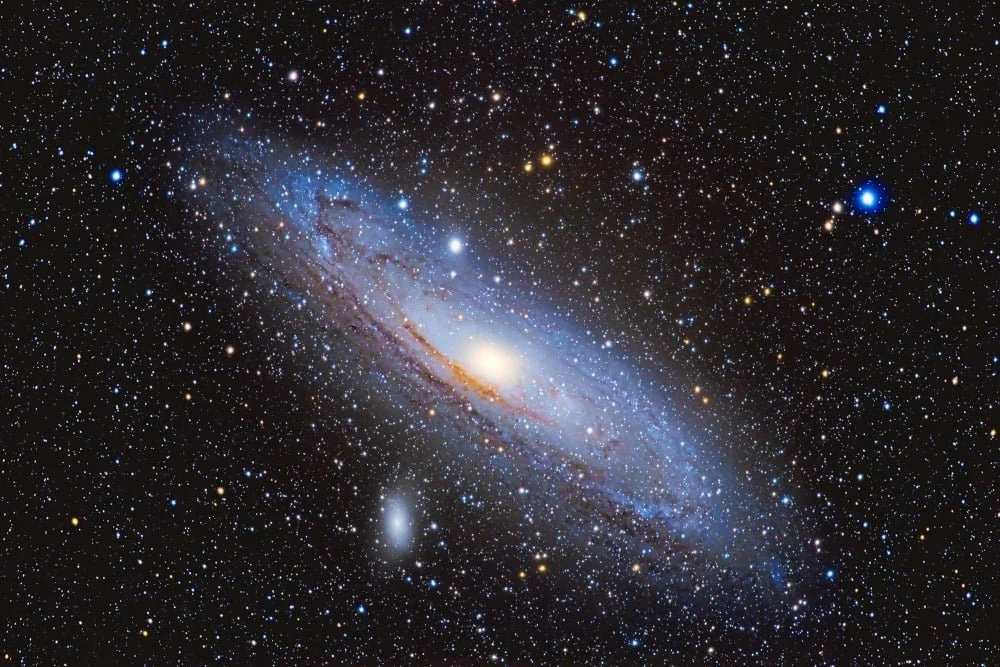
The Andromeda Galaxy is a highlight of the skies in fall. Image by Jeremy Nickoson
Parking passes for this fall’s programs can be found here:
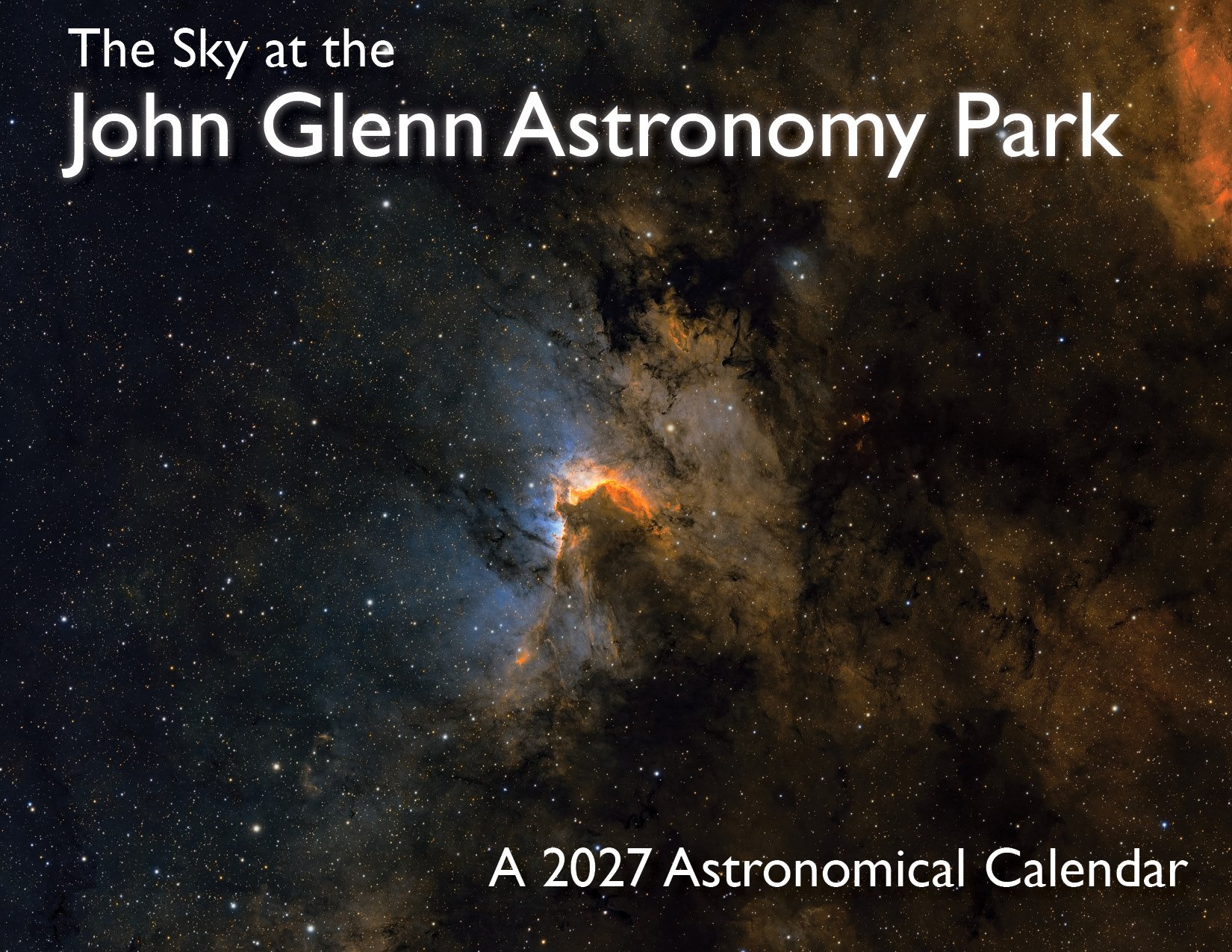
The All New 2027 JGAP Astronomical Calendar is Here!
This calendar features hundreds of bits of astronomical information:
- Moon Phases
- Sunrise/Sunset/Twilight times
- Celestial events- Planetary conjunctions, occulations, oppositions, Jupiter shadow transits, and so on.
- Astronomical Anniversaries, birthdays of famous astro-folk and anniversaries of various astronomical events
- The "Cosmic Calendar" which compresses the entire history of the universe into a single year, inspired by the sequence in "Cosmos" hosted by Carl Sagan.
- Dates of various planetary mission events
The main text directs your gaze to the most compelling celestial objects that month.
All this is accompanied by amazing imagery taken by the astrophotographers at the John Glenn Astronomy Park.
Proceeds benefit the programs at JGAP.
Pick it up at ESTY.COM here.
Thank you!

JGAP Is a dark site deigned to give people a place to enjoy pristine, starry skies. It takes time for human eyes to adapt to dark conditions after they have experienced bright lights.
So, please be considerate to others when driving in after dark and turn your high beams down. This helps keep our observing field dark. Then, once you have parked, please turn off your headlights right away.
If you have trouble in the dark finding your way to our field from the parking area, wait a minute or two without exposing yourself to bright light. Then walk. You’d be amazed what your eyes can do if you just give them a chance.
01. Fall Skies
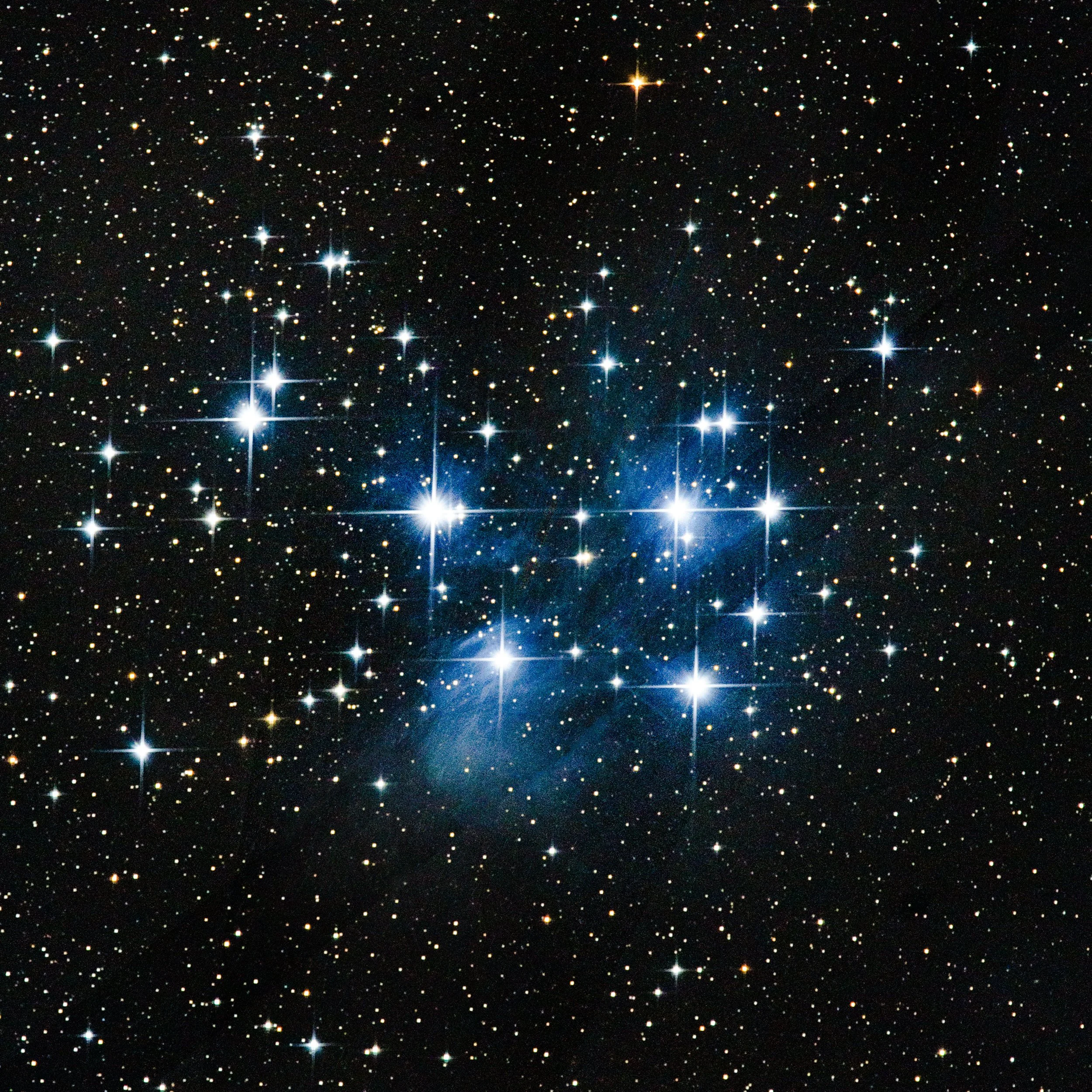
The Pleiades (M45) is part of the constellation Taurus. They rise over the eastern horizon late on mid-fall evenings, and at sunset near the end of the season. Made up of over 1,000 stars, and relatively close to our solar system, most humans can see 6 (or 7) stars without the aid of a telescope. In binoculars it blooms into a spray of dozens of stars.
For stargazers, fall is “the best of both worlds”. Fall nights start right after dinner, and temperatures are still moderate.
Better still, in Ohio, skies are often clear.
The night side of the Earth points out towards some familiar, and not-so-familiar constellations. Setting in the west are the “Summer” constellations, amongst them Cygnus, Hercules and Aquila. Rising in the east and northeast are the enormous square of Pegasus, the twin lines of Andromeda, and the striking “W” (or “M”) of Cassiopeia.
As evening rolls on, the two great galactic companions of our Milky-Way, The Andromeda Galaxy and M33 rise high in the sky and are easily seen in binoculars. If skies are clear, and there is no moon, The Andromeda Galaxy can be seen with the unaided eye!
Drawing the eye, late in the evening, is the familiar clump of stars, The Pleiades.
02. Astrophotography

Image by Alex Mullins
On most clear, moonless, evenings, you’ll find folks taking advantage of the dark skies at JGAP to shoot images of the night sky.
This pastime is known as astrophotography.
All are welcome to bring cameras and telescopes to JGAP to try their hand at this.
If you get a good image, why not share it with us by using our Instagram hashtag: #jgastropark
Predicting the Weather
The Clear Sky Clock
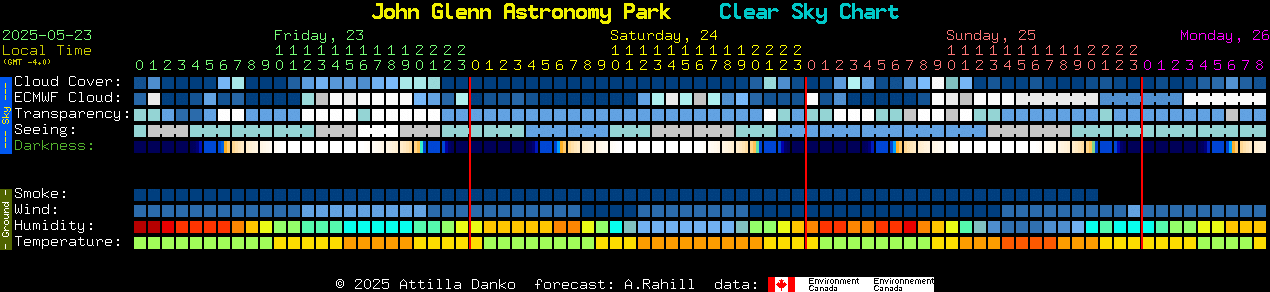
The chart below is an hour by hour prediction of how clear the skies will likely be over the coming two days. Cloud cover and transparency are the critical data points. In general, dark blue is best. If both transparency and Cloud Cover are indicated as dark blue, then skies are likely to be clear and filled with stars. Lighter colors are proportionally worse.
In recent months, the predictions of the Clear Sky Clock have been somewhat unreliable, so use at your own risk.
Clear Outside
The forecasts from the website Clear Outside have proven very accurate and reliable in recent months and give a great indication of what sort of clouds to expect, if any.
ClearOutside forecast for the Hocking Hills
Astrospherics
Another great site for predicting conditions on an hour by hour basis is Astropherics, whose model of late is better than that of the Clear Sky Clock. Access JGAP’s location with this link:
Weather.Gov
Finally, the best site for predicting the weather is the site from which all the data comes from in the first place, the National Oceanic and Atmospheric Administration’s forecast page. The best forecast for JGAP is the Logan, Ohio hourly pinpoint forecast. Find it here.
The most critical part of the forecast is the blue line which represents the predicted cloud cover for that hour. Generally 50% or higher is not good.
Incidentally, Weather.gov is a product of NOAA, the National Oceanic and Atmospheric Administration, which has suffered devastating cutbacks in recent months that may undermine its very existence. NOAA provides data that commercial services call upon for their own forecasts as well as conducts research that helps improve forecast models in the future. Many people have fought hard to maintain this valuable public service and some funding has been restored, but there is still much work to do. Please consider speaking up for it.
Support the Friends of the Hocking Hills State Park
Do you love the Hocking Hills State Park? Would you like to help projects that make HHSP an even better place? Do you love JGAP?
Then consider joining The Friends of the Hocking Hills State Park, an organization that supports projects like JGAP and other enhancements to the most beautiful park in Ohio.
http://www.friendsofhockinghills.org/
Join our Facebook and Instagram Communities
We have a Facebook page
https://www.facebook.com/JohnGlennAstronomyPark/?ref=bookmarks
… and an Instagram Page
https://www.instagram.com/jgastropark/
On both we are regularly featuring items of astronomical interest.
If you have questions that you’d like addressed in these feeds, feel free to Facebook Messenger them to us!
“The greatest thing we can do is inspire young minds...”
- John Glenn
